
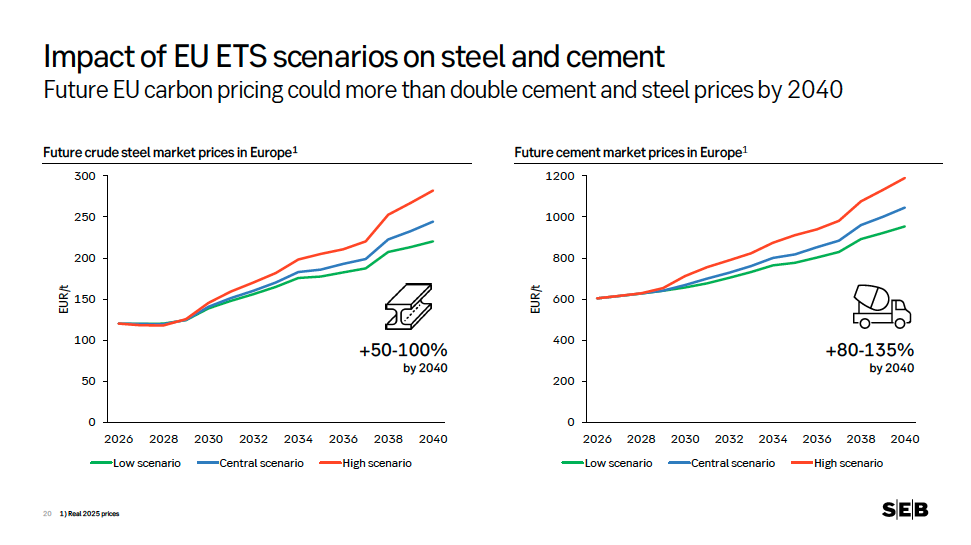
SEB’s latest Sustainable Finance Outlook suggests that future carbon prices could dramatically change the economics of cement and steel in Europe. We looked more closely at the numbers – and what they could mean for companies making material decisions in an increasingly fast-moving market.
The European construction industry has spent years discussing how to reduce embodied carbon emissions.
But carbon is increasingly becoming more than an environmental metric. Through the EU Emissions Trading System, it is becoming a direct economic factor in the production and use of construction materials.
SEB’s recently published Sustainable Finance Outlook – Europe’s Carbon-Policy Balancing Act provides an interesting analysis of how significant that change could become.
What SEB’s analysis tells us
Carbon prices could rise significantly
The EU ETS already covers approximately 40% of EU greenhouse gas emissions, and emissions in sectors covered by the system have fallen by more than 50% since 2005.
However, much of the historical reduction has come from the power sector. SEB’s analysis points towards energy-intensive industries such as steel and cement needing to contribute a larger share of future reductions.
At the same time, the economics of emitting carbon have already changed substantially.
EU allowances averaged below €10 per tonne between 2012 and 2018, compared with approximately €60-100 per tonne since 2021.
SEB’s scenarios suggest another substantial increase could lie ahead. By 2040, it estimates carbon prices of approximately:
- €180/t in its low scenario
- €215/t in its central scenario
- €270/t in its high scenario
The trajectories depend on several factors, including the effectiveness of industrial decarbonisation policies, subsidies, carbon removals and access to international carbon credits.
The important point is that there isn’t one predetermined carbon-price future. Companies will have to make long-term investment decisions while the eventual price remains uncertain.
Cement and steel could feel the impact directly
For carbon-intensive materials, SEB expects the consequences to be substantial.
Its scenarios indicate that European steel prices could increase by approximately 50-100% by 2040, while cement prices could increase by approximately 80-135%.
For cement, SEB starts from a market price of around €120 per tonne and estimates increases ranging from roughly 80% in the low-carbon-price scenario to approximately 135% in the high scenario by 2040.
But those increases don’t translate directly into equivalent increases in construction costs.
The construction-cost impact is much smaller, but the margin impact isn’t
Under SEB’s central scenario, the estimated increase in total European construction costs by 2040 is around 1.5% for commercial offices and 1.9% for residential buildings, while more material-intensive projects could experience increases above 3%.
Those numbers may initially appear relatively manageable.
But SEB’s analysis shows how a relatively small increase in total project cost can have a disproportionately large impact on profitability.
Depending on portfolio mix, SEB estimates potential reductions in developer margins of approximately 15-40%. Material-intensive infrastructure is at the upper end of the range, while residential-focused portfolios are less affected.
Europe is balancing decarbonisation with competitiveness
The balancing act in SEB’s report title is important.
The European Commission’s proposed changes include a slower reduction in allowances after 2030, changes to the Market Stability Reserve, potential access to international carbon credits and removals, and extended free allocation for CBAM sectors.
These measures could moderate future carbon prices compared with previous expectations while maintaining pressure to decarbonise.
The policy challenge is therefore increasingly about achieving two objectives simultaneously: reducing industrial emissions while maintaining European industrial competitiveness.
From ambition towards implementation
SEB also highlights a shift in how the transition is supported.
Under proposed reforms discussed in the report, 80% of relevant free allocation would be provided upfront, with 20% linked to the implementation of decarbonisation investments.
This points towards a broader change: transition is increasingly about the ability to turn ambition and investment plans into actual implementation.
Ecometrix’s view: what does this mean for industry?
SEB’s report is primarily an analysis of carbon policy, pricing and financial consequences.
Our interest is what happens when these forces reach the everyday decisions made by material producers, engineers, construction companies and developers.
We see three broader implications.
1. The material equation is becoming more complex
For decades, engineers and producers have balanced familiar variables such as technical performance, quality, availability and cost.
Carbon increasingly becomes another economic variable in that equation.
Performance + Cost + Carbon + Availability + Regulation
And these variables interact.
Reducing cement content may lower both carbon and cost – but only if technical requirements can still be met. A lower-carbon binder may perform differently, cost more or be less readily available. A technically optimal solution may no longer be economically optimal under a different carbon price.
The optimal balance isn’t universal either.
Materials, labour costs, construction methods, specifications and supply chains differ between markets. A solution that works in Stockholm may not create the same technical, environmental or economic outcome in Mumbai.
This is particularly relevant when interpreting SEB’s construction-cost analysis. Its estimates concern Europe. In markets where materials represent a larger proportion of overall construction costs, changing cement and steel prices could have a different impact on project economics.
Knowledge can travel. Optimal solutions need to be local.
2. Pace becomes a competitive factor
Perhaps the less obvious consequence is speed.
Carbon prices, material availability, regulation, technology and customer requirements are all moving.
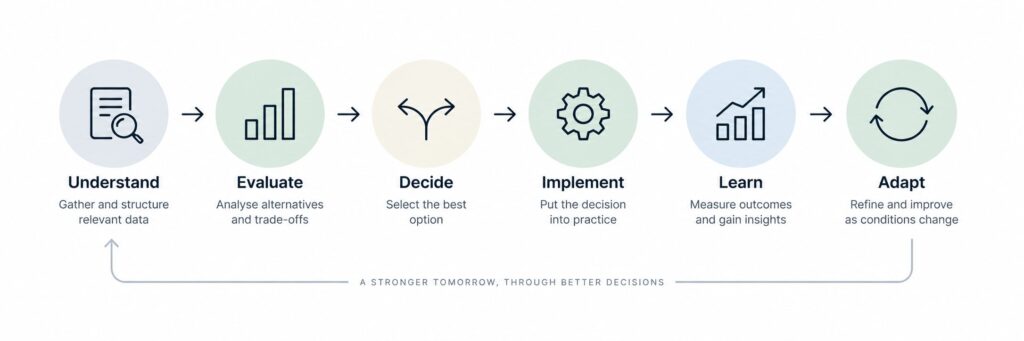
Companies therefore increasingly need to repeat the same cycle:
Historically, developing a new material, modifying a concrete recipe, qualifying an alternative supplier or changing a technical specification could be a relatively slow process.
That becomes increasingly costly when the economic environment surrounding those decisions is changing faster.
The question is therefore no longer only:
Can we find a better solution?
It is increasingly:
How quickly can we identify it, validate it, implement it and learn from the outcome?
Companies with a greater capacity to adapt can respond faster as carbon prices, material availability, regulation and customer requirements change.
That could make speed of learning and implementation an increasingly important part of industrial competitiveness.
3. Better data becomes more valuable as decisions become more complex
More complex decisions require better information.
The construction and material industries already generate enormous amounts of it: material specifications, recipes, laboratory results, EPDs, supplier documentation, production data, costs and historical performance.
The challenge is often not the absence of information.
It is turning fragmented information into something that can actually support a decision.
As the number of variables increases – and the time available to respond decreases – the ability to structure information, compare alternatives and learn from previous outcomes becomes more valuable.
AI creates new possibilities here, not by replacing engineering expertise, but by helping people analyse more information, evaluate more alternatives and learn from historical data faster than traditional processes allow.
From decarbonisation target to decision capability
Perhaps the most important question raised by SEB’s analysis isn’t whether the carbon price eventually reaches €180, €215 or €270 per tonne.
Nobody knows exactly what that number will be.
What appears clearer is the direction of travel.
Carbon is increasingly being incorporated into the economics of industrial materials. Policy incentives are becoming more closely connected to implementation. And companies are being asked to balance decarbonisation with performance, cost and competitiveness.
That changes the nature of the challenge.
Having ambitious targets matters. Developing new technologies matters.
But so does the organisational capability to make better decisions as conditions change.
The companies best positioned for that transition may not be those that simply minimise carbon at any cost.
They may be those that become better at continuously balancing performance, cost and carbon – and can turn better decisions into implementation faster.
About Ecometrix
Ecometrix develops AI and analytics solutions that help industry turn complex material and supply-chain data into better decisions. By combining trusted data, engineering expertise and AI, we help organisations evaluate alternatives and balance technical performance, environmental impact and economics.
We call this Material Intelligence.
Source: SEB, Sustainable Finance Outlook – Europe’s Carbon-Policy Balancing Act, September 2026. Carbon-price, material-price, construction-cost and developer-margin scenarios referenced in this article are SEB estimates and should not be interpreted as Ecometrix forecasts.