
When discussing sustainable construction, procurement often takes center stage. The focus is usually on selecting low-carbon materials, evaluating suppliers, and reducing emissions through purchasing decisions.
But what if the biggest opportunity to reduce a building’s climate impact comes long before procurement begins?
In this episode of Concrete Action Towards Net Zero, Anders Enebjörk (profile link), Sustainability Specialist at NCC (link), a leading construction company in the Nordics, explains why the design phase may be the most powerful lever for reducing emissions in construction.
His message is simple: before choosing better materials, we must first design smarter buildings.
A Three-Phase Model for Sustainable Construction
According to Anders, low-carbon construction can be viewed through three connected phases:
- Design the building – Decisions about geometry, structure, and complexity determine how much material will ultimately be required.
- Define material requirements – Performance requirements such as concrete strength classes influence both carbon impact and cost.
- Procure the right materials – The final step is selecting climate-improved materials and suppliers.
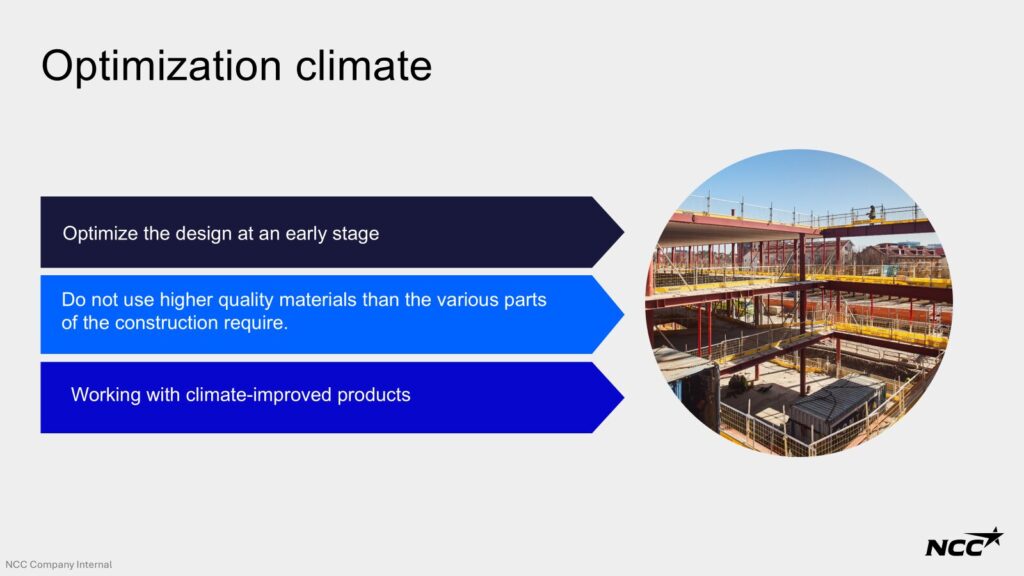
The key insight is that low-carbon materials often come at a premium. By optimizing the first two phases, project teams can reduce material demand and create room in the budget for more sustainable choices.
Designing Out Emissions
Many sustainability discussions begin with materials. However, some of the most important climate decisions are made much earlier.
The earliest design decisions determine how efficiently a building can be constructed. Simple structural concepts, where loads travel directly through walls and columns, often require less material than more complex designs.
Optimising these decisions can reduce a project’s climate impact by as much as 20–30%.
These early choices shape both the environmental impact and material requirements of a project long before procurement begins.
Reducing Material Demand Through Better Design
The industry often focuses on replacing conventional materials with lower-carbon alternatives. While material innovation remains important, some of the largest opportunities lie in reducing the amount of material required in the first place.
Construction projects frequently rely on familiar designs and specifications because they have worked before. However, modern engineering tools make it possible to calculate requirements more accurately and optimize structural details based on actual needs rather than standard assumptions.
This can reduce both concrete volumes and reinforcement requirements without compromising safety or performance. The result is lower embodied carbon, lower material costs, and greater flexibility to incorporate climate-improved materials where they create the greatest impact.
Rather than treating sustainability and profitability as competing priorities, material efficiency demonstrates how the two can reinforce one another.
Collaboration Creates Better Outcomes
Low-carbon construction also requires a different way of working.
Traditional projects often follow a linear process where specifications are fixed and suppliers compete primarily on price. Anders highlights the importance of greater transparency and collaboration between clients, contractors, and suppliers.
By working together earlier in the process and aligning around shared objectives, teams can identify opportunities to reduce both costs and emissions across the entire project lifecycle.
Sustainability as a Competitive Advantage
As clients introduce increasingly ambitious climate targets, sustainability expertise is becoming a competitive differentiator.
NCC has invested heavily in internal knowledge and specialist capabilities, enabling the company to help clients meet demanding carbon reduction goals while maintaining project feasibility and quality.
As Anders notes, organisations that develop this expertise today will be better positioned to lead the transition tomorrow.
Looking Forward
The path to net zero construction will not be defined by a single material innovation. It will be shaped by a series of small decisions made long before construction begins, during construction and also how you scale your learnings into the next project..
This episode highlights an important lesson for the industry: meaningful carbon reductions start with design. By reducing material demand, challenging assumptions, and collaborating across the value chain, construction leaders can unlock significant climate benefits before procurement even starts.
Follow the Concrete Action Towards Net Zero series as we continue exploring the practical actions, partnerships, and innovations driving the transition toward a more sustainable built environment.